Pain that travels from the lower back into the buttock or leg, combined with numbness, weakness or reduced walking tolerance, needs more than a pain score. By the end, you will know which findings support a nerve-root diagnosis, when neurolysis enters the discussion, what alternatives target, and which questions to settle before scheduling it.
Key takeaways
- Seek urgent care for progressive weakness, saddle numbness, or bladder and bowel changes.
- Confirm the painful nerve pathway before considering epidural neurolysis.
- Compare neurolysis with physical therapy, injections, medicines, and surgery when appropriate.
- Track pain, walking, sleep, strength, and medication use after treatment.
What persistent nerve-related back pain looks like in daily life
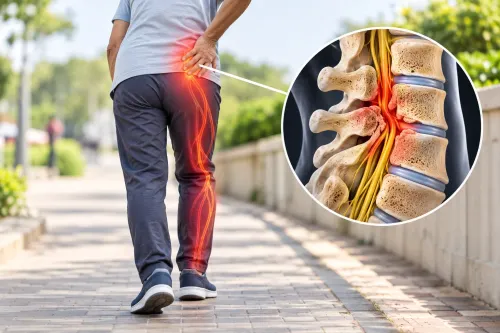
Persistent nerve-related back pain usually means symptoms continuing for at least six to 12 weeks despite treatment; no universal cutoff exists. It can disrupt sitting, walking, sleep, driving, or lifting. New progressive weakness, saddle numbness, bladder or bowel loss, fever with severe pain, or rapid neurological worsening needs urgent assessment.
Patterns that favour a nerve over muscle or joint pain include:
- Radiating leg pain from the low back or buttock into the thigh, calf, or foot, especially on one side.
- Sciatica symptoms such as burning, electric, shooting, or shock-like pain.
- Numbness and weakness, foot catching, knee buckling, or difficulty standing on your toes or heels.
- Pain worsened by coughing, sneezing, straining, or prolonged sitting rather than only by lifting or local movement.
| Pattern | What you notice in daily life | More consistent with |
|---|---|---|
| Nerve-root pain | One-sided pain follows a recognisable path into the leg, with tingling, numbness, or weakness | Irritated or compressed nerve |
| Muscle pain | Local aching and tenderness, with pain when the muscle contracts or stretches | Strained or overloaded muscle |
| Facet or sacroiliac joint pain | Pain stays near the back or buttock and changes with specific positions, without clear sensory loss | Spinal or pelvic joint pain |
| Hip pain | Groin or outer-hip pain, stiffness, and difficulty rotating the leg or climbing stairs | Hip joint disease |
How clinicians confirm the painful nerve pathway
A convincing history links pain to a single nerve-root territory rather than merely recording back pain. Ask where it travels, whether it follows a dermatomal pain pattern into the buttock, thigh, calf or foot, and whether coughing, sitting, walking or spinal movement changes it.
Numbness, tingling and task-specific weakness strengthen the case; diffuse aching without a consistent distribution points elsewhere.
The examination tests whether the reported pathway has objective support:
- Compare sensation on both sides for reduced feeling in the suspected root’s territory.
- Perform muscle strength testing in movements supplied by that root, looking for weakness that affects walking, lifting the foot or standing on the toes.
- Check reflex changes, such as a reduced knee or ankle reflex.
- Use straight-leg raise or femoral stretch to reproduce familiar radiating pain, then examine the hip, sacroiliac region, facet joints and peripheral nerves for competing sources.
Imaging must match the symptoms and examination, not replace them. MRI can show a disc herniation, lateral-recess or foraminal narrowing, postoperative scar, or another lesion contacting the corresponding root on the painful side. MRI epidural fibrosis is not, by itself, a reliable pain diagnosis because scar is common after lumbar surgery.
Clinicians weigh the scan against the operative history and neurological findings. Progressive weakness, saddle numbness, or bladder or bowel loss requires urgent assessment.
When neurolysis is considered—and how it compares with other treatments
Neurolysis becomes reasonable when failed conservative treatment includes exercise-based rehabilitation, medication review and activity modification, yet leg-dominant nerve pain continues. The main epidural neurolysis indications include short-lived or absent relief after an epidural steroid injection, persistent symptoms after lumbar surgery, or suspected epidural adhesions that restrict medication reaching a nerve root.
MRI-visible scar alone does not prove that scar causes pain. The scan must match the painful side and distribution, neurological findings, operative history and any foraminal or lateral-recess narrowing. Do not use neurolysis instead of decompression surgery when progressive weakness, severe neurological compromise or a clearly correctable lesion requires surgical treatment.
At Spine And Pain Management Centre, the useful decision is whether the pattern and prior treatment response justify a catheter-based procedure rather than simply repeating an injection.
| Option | What it does | When it applies |
|---|---|---|
| Epidural neurolysis | Uses a targeted catheter to disrupt or bypass adhesions and deliver medication | Persistent radicular pain after conservative care, injections or surgery |
| Epidural steroid injection | Places anti-inflammatory medicine in the epidural space | Suspected nerve-root inflammation without a reason to mechanically address adhesions |
| Selective nerve-root block | Delivers anaesthetic, often with steroid, beside one nerve root | Confirming the pain source or providing focused temporary relief |
| Radiofrequency treatment | Uses heat to interrupt selected pain-carrying nerves, usually facet-joint nerves | Facet-mediated back pain, not typical nerve-root compression |
| Decompression surgery | Removes bone, disc or another structure compressing the nerve | Progressive deficit or a surgically remediable lesion |
Neurolysis is more technically involved than an injection and carries added risks, including dural puncture, bleeding, infection and nerve injury. Its benefit is assessed through function over subsequent months, not a permanent cure.
Related service
Pain Treatment ₹700 Dr Prakash Deshmukh at Spine and Pain Management Centre in Kalyan offers advanced Epidural Neurolysis Treatment for patients suffering from chronic... View service → |
What the procedure and preparation involve
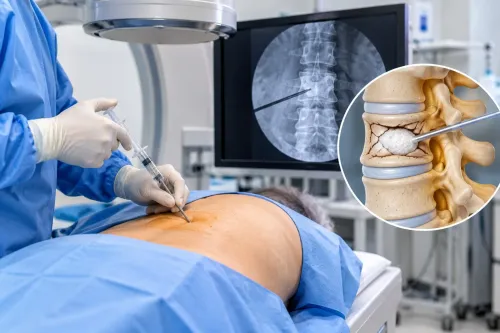
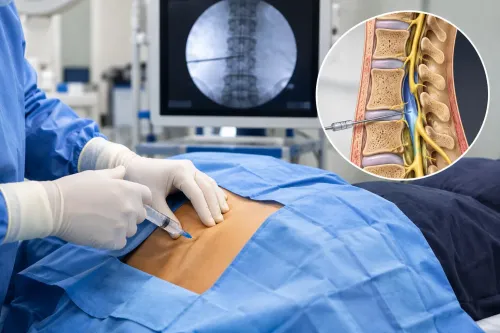
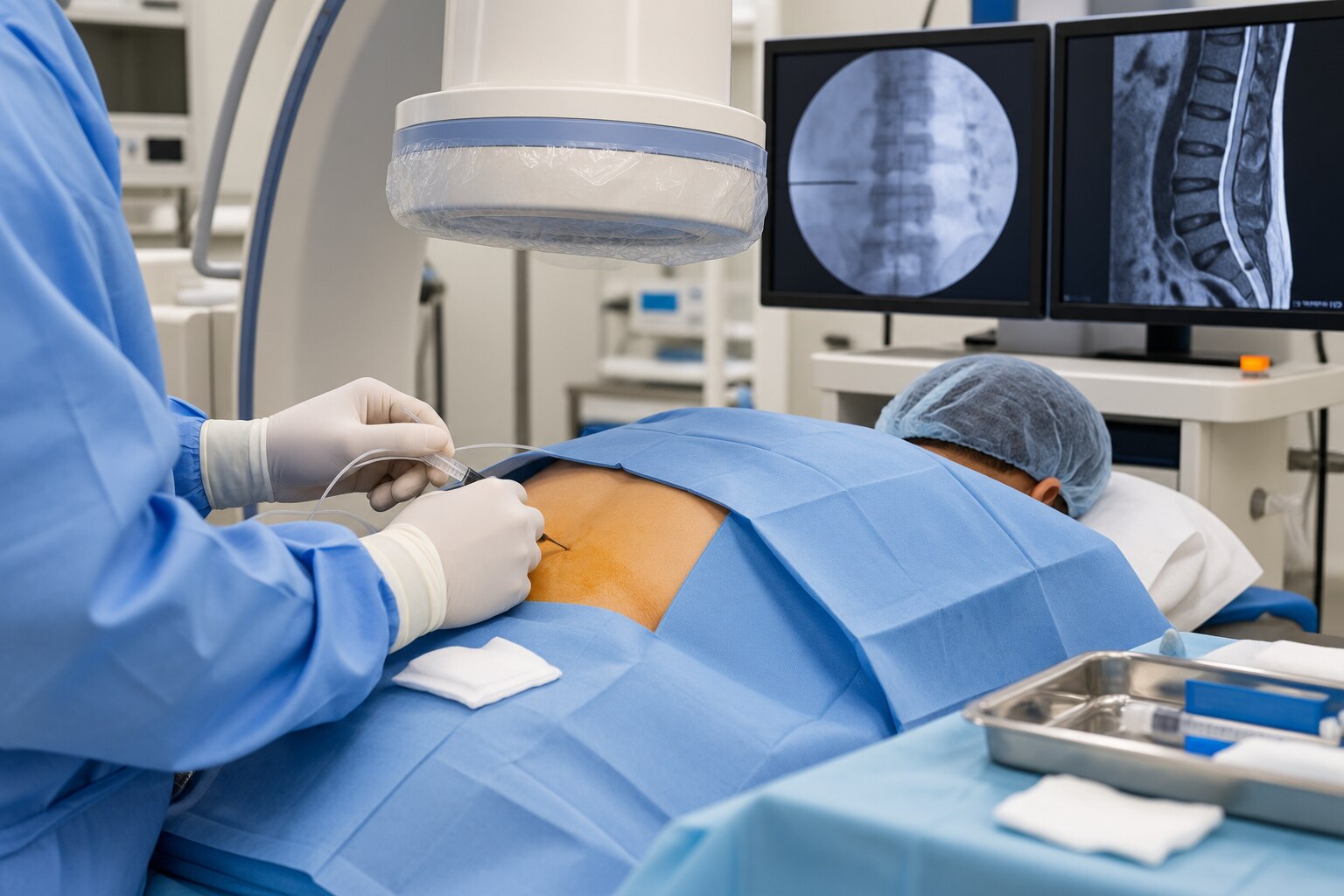
A catheter is guided through the skin into the epidural space during percutaneous epidural adhesiolysis, also called the Racz procedure. Using fluoroscopy and contrast epidurography, the operator confirms the catheter’s position and directs it toward the symptomatic nerve-root level. Mechanical catheter movement may disrupt or bypass scar tissue that restricts the pathway.
| Ordinary epidural injection | Delivers medication into the epidural space through a needle | Used for medication-based treatment without catheter manipulation |
|---|---|---|
| Epidural adhesiolysis | Adds targeted catheter placement and possible mechanical treatment of adhesions | Considered when scarring or restricted nerve-root passage is suspected |
The operator may inject saline, local anesthetic and a corticosteroid. Depending on the protocol, hyaluronidase or hypertonic saline may also be used; drug combinations are not standardized across clinics or studies.
Before scheduling treatment, address these issues:
- Review anticoagulants and antiplatelet drugs as part of checking blood thinners before spinal procedure. Do not stop them yourself; the proceduralist and prescribing clinician must balance spinal bleeding against thrombosis.
- Defer treatment for active infection, suspected epidural infection or an uncontrolled bleeding disorder.
- Discuss contrast allergy, kidney disease, pregnancy, diabetes and immunosuppression so the plan can be adjusted.
- Report medicines, allergies and previous reactions to anaesthetic or contrast agents.
- Ask how positioning, sedation and monitoring will be managed if severe pain or limited mobility makes lying prone difficult.
Potential complications include dural puncture, headache, bleeding, infection, allergic reaction, temporary weakness or numbness, nerve injury and medication-related effects.
How to judge recovery, benefit and the need for further care
Neurolysis recovery usually begins with temporary post-procedure soreness, bruising or increased leg pain around the needle and catheter sites. These symptoms should settle over several days; contact the treating team if they intensify instead of easing.
Assess early safety within the first few days, then judge benefit over several weeks to a few months. A successful response means more than a lower pain score: walking farther, sleeping better, returning to work, reducing rescue medication, or tolerating daily activities shows functional improvement.
| Finding | What it means | Next step |
|---|---|---|
| Pain relief with better walking or sleep | Clinically meaningful benefit | Continue the agreed rehabilitation plan and monitor durability |
| Brief relief without functional improvement | Insufficient evidence of useful treatment | Reassess the diagnosis and other pain sources |
| Pain returns after months | The underlying narrowing or degeneration remains | Review imaging, nerve findings and alternative treatments |
| New weakness, numbness, bladder or bowel difficulty | Possible nerve injury or compression | Seek urgent medical assessment |
Fever, worsening back pain, drainage, severe headache when upright, new leg weakness, loss of sensation, or difficulty urinating require prompt evaluation for epidural procedure complications such as infection, bleeding or dural puncture.
Repeat treatment should follow documented meaningful benefit and a diagnosis that still fits. Fixed-interval procedures without functional improvement have weak justification; ask what specific outcome would justify another procedure.
Frequently asked questions
What does persistent nerve-related back pain feel like in daily life?
It can cause radiating pain, tingling, numbness, or weakness that disrupts sitting, walking, sleep, driving, or lifting. Symptoms lasting six to 12 weeks despite treatment are commonly described as persistent, although no universal cutoff exists.
How do clinicians confirm the painful nerve pathway?
Clinicians combine your symptom pattern and neurological examination with imaging such as MRI when indicated. They may also use electrodiagnostic testing or a targeted diagnostic injection to assess whether a specific nerve root is causing the pain.
When is epidural neurolysis considered?
It may be considered when nerve-related pain persists despite appropriate non-surgical treatment and scar tissue or adhesions around a spinal nerve are suspected. A clinician must first assess the diagnosis, risks, alternatives, and urgent warning signs.
How does epidural neurolysis compare with other treatments?
The comparison depends on the cause and severity of pain. Options can include exercise-based physical therapy, medicines, epidural injections, radiofrequency procedures for selected pain sources, or surgery when significant compression or progressive neurological loss requires it.
What does recovery after epidural neurolysis involve?
Your care team will explain activity limits, warning signs, medication changes, and follow-up. Judge benefit by changes in pain, function, sleep, walking tolerance, strength, and reliance on pain medicines rather than pain intensity alone.