Walking that becomes painful, heavy or unreliable after a predictable period can reflect more than poor fitness or a back problem. By tracking posture, distance, recovery and changes in leg function, you can give a clinician useful information and recognise when limited mobility needs prompt assessment.
Key takeaways
- Bending forward or sitting can ease stenosis-related leg symptoms.
- Heaviness, tingling or weakness after standing points toward nerve compression.
- Track walking distance, posture, recovery time and affected tasks.
- Seek medical attention urgently for new bladder, bowel or severe leg weakness.
Why walking distance changes with posture
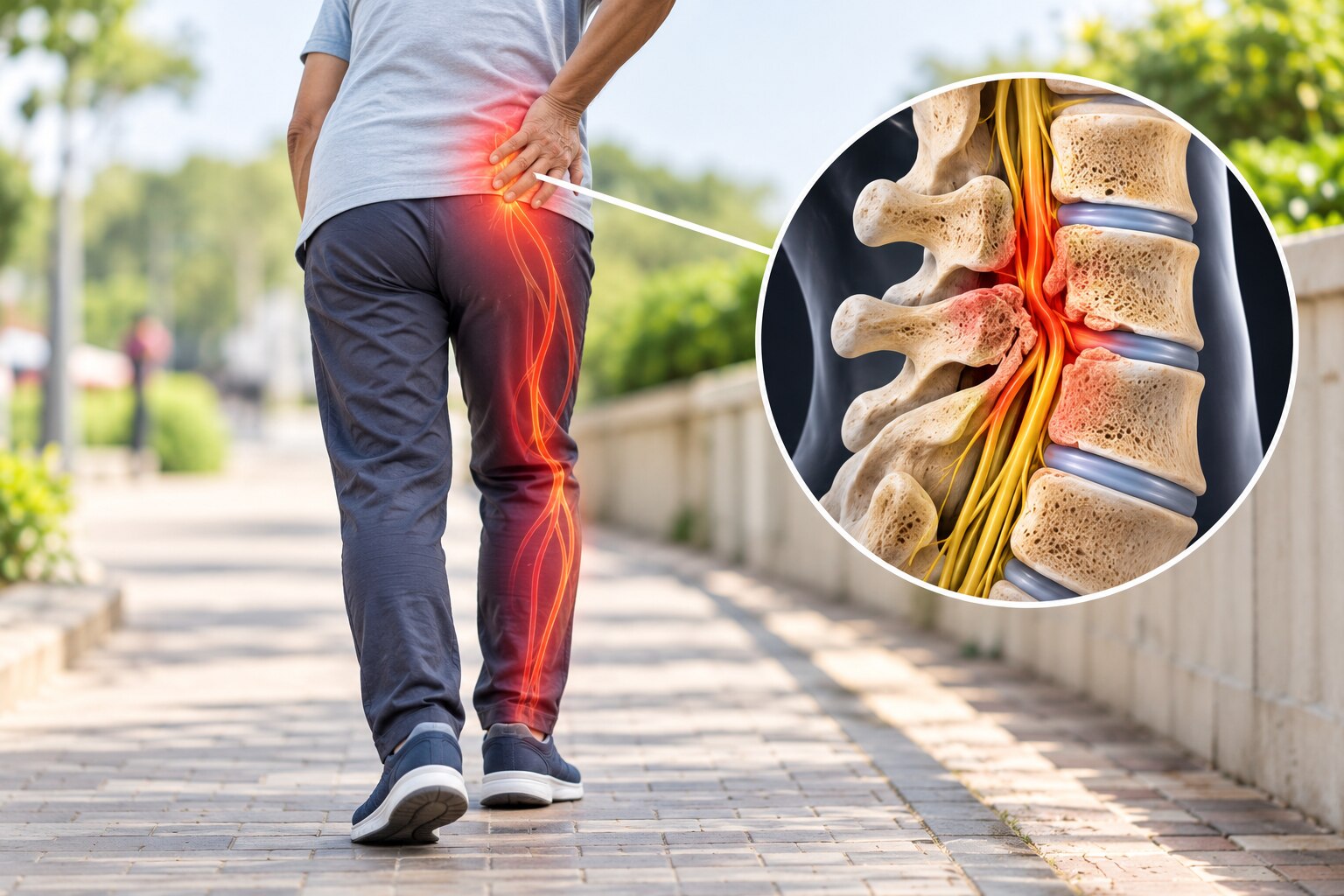
The key difference is spinal posture: standing and walking extend the lower back, while sitting or bending forward flexes it. In lumbar canal stenosis, extension can further narrow the space around the nerve roots. That pressure produces neurogenic claudication, causing leg discomfort, heaviness, tingling or weakness after a period upright.
Your walking distance may therefore look inconsistent. You might begin normally, then develop symptoms after several minutes; stopping without sitting may not help much. Sitting or leaning forward reduces the pressure, so symptoms often settle faster than they would while you remain standing.
Your standing tolerance can be far shorter than the time you can spend seated.
The posture clue appears in ordinary activities. Downhill walking and standing at a counter often bring symptoms on sooner than uphill walking, because they keep the lumbar spine more extended. Leaning on a shopping trolley, resting over a walker or bending forward over a kitchen counter can increase walking tolerance.
A slower pace, repeated pauses and shorter shopping trips reflect the same mechanism.
A normal strength or reflex test while you sit does not rule out symptomatic stenosis. Tell a clinician how long you can walk, whether sitting provides relief, and which posture changes the symptoms. That history can be more revealing than a single comfortable examination at rest.
What leg discomfort can reveal about the cause
The strongest clue is not the pain label but the trigger-and-relief pattern. Lumbar stenosis points toward neurogenic claudication when walking or standing brings on symptoms in the buttock or leg, while sitting or bending forward settles them. Low-back pain can be mild or absent.
| Pattern | Clues that support it | Clue against lumbar stenosis |
|---|---|---|
| Lumbar stenosis | Leg heaviness, burning, tingling, numbness or weakness in one or both legs after walking or standing; relief with sitting or leaning forward | Symptoms are unrelated to posture or activity |
| Vascular claudication | Calf or foot cramping at a reproducible walking distance; relief after stopping, even while standing; cool feet or weak pulses | Sitting or bending forward is necessary for relief |
| Hip or knee arthritis | Pain centred in the groin, hip or knee, with joint stiffness, reduced movement or pain during joint loading | Prominent tingling, numbness or symptoms extending below the joint |
| Peripheral neuropathy | Burning, tingling or numbness in both feet, often present at rest or at night, with balance difficulty | Symptoms reliably start with walking and settle only after sitting |
| Deconditioning | General fatigue, breathlessness and diffuse muscle tiredness after effort | Focal leg symptoms or posture-specific relief |
These patterns overlap, so an examination of pulses, joints, strength, sensation and reflexes matters. A scan cannot prove the cause by itself; the image must match your symptoms and walking pattern. Rapidly worsening weakness, new bladder or bowel trouble, or numbness around the genitals or anus requires urgent assessment.
How mobility changes everyday tasks
A change in function can reveal more than pain intensity. Leg heaviness, numbness, tingling, fatigue or perceived weakness may make you shorten steps, pause repeatedly, use a railing or avoid outings even when your back does not hurt much.
| Activity | Record what changes | What it may show |
|---|---|---|
| Standing to cook | Minutes before you lean on the counter, sit or stop; whether bending forward helps | Symptoms triggered by upright posture |
| Climbing stairs | Number of steps, need for a railing, slower ascent or leg weakness | Reduced strength, endurance or balance |
| Bathing | Difficulty standing, stepping over the edge, or remaining steady | Sensory loss, weakness or fall risk |
| Getting into a car or walking to a bus stop | Trouble lifting a leg, walking the distance, or completing the trip without pauses | Loss of practical community mobility |
Before your appointment, record the walking distance or minutes until symptoms begin, whether sitting or leaning forward settles them, and whether one or both legs are affected. Describe the sensation precisely: aching, burning, cramping, tingling, numbness, heaviness or weakness. Note falls, near-falls, a new walking aid, and whether cycling is easier than walking.
Bring the pattern rather than relying on an MRI report. Narrowing on an image does not prove it caused your limitation; the scan must match your symptoms and functional changes.
When walking limitation needs medical attention
A gradual reduction in walking distance deserves medical assessment even when pain is mild or absent. Slower steps, repeated pauses, increasing reliance on a railing or walker, and falls signal functional loss that should not be explained away as ageing or poor fitness.
Arrange an appointment if these changes persist, worsen, or interfere with work, shopping, or personal care.
| Change | Action | Why it matters |
|---|---|---|
| Walking ability gradually declines | Book a clinical assessment | Leg heaviness, numbness, fatigue, or weakness can progress without severe back pain |
| Balance worsens or falls begin | Seek prompt assessment | Sensory loss or weakness can make ordinary walking unsafe |
| Rapidly worsening leg weakness | Obtain urgent medical assessment | Progressive nerve compression needs prompt examination |
| New bladder or bowel difficulty | Seek emergency assessment now | Retention, incontinence, or loss of bowel control can indicate cauda-equina compression |
| Saddle numbness | Seek emergency assessment now | Numbness around the genitals or anus is an emergency warning sign |
Do not rely on a normal seated examination to dismiss your symptoms. Strength, sensation, and reflexes can appear normal at rest, so tell the clinician exactly how walking changes your legs and whether symptoms improve after sitting or bending forward.
Rapid deterioration, especially with bilateral weakness or any bladder, bowel, or saddle symptoms, should be assessed immediately rather than monitored at home.
How functional loss guides the next decision
Let functional loss guide the decision: worsening walking tolerance, leg symptoms and matching neurological findings favour escalation; stable function without a progressive neurological deficit supports non-operative care.
A seated examination can look reassuring even when stenosis limits walking. Strength, sensation and reflexes may be normal at rest, so describe your distance, posture-related relief and pauses; the clinician may observe you after walking when appropriate.
The discussion usually follows this pattern:
- Non-operative care: Use education, activity modification, trunk and hip strengthening, aerobic conditioning, strengthening and balance work. Exercises should target the activities that provoke symptoms; passive treatment alone is less likely to restore walking capacity.
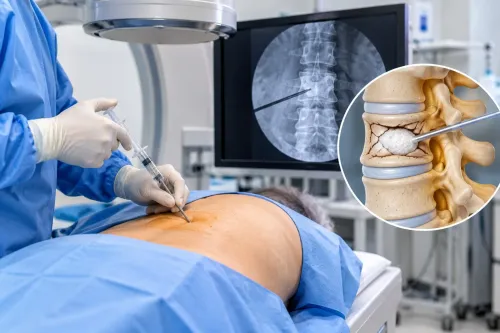
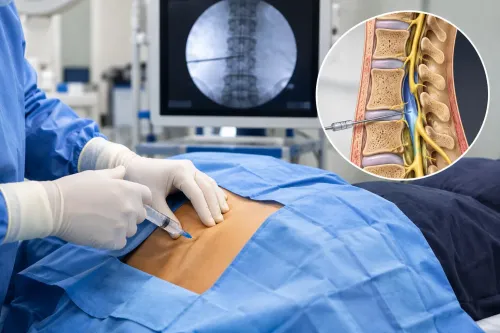
- Epidural injection: Consider it for short-term relief when leg symptoms restrict rehabilitation or daily activities. It does not enlarge the canal, and repeated injections should not replace reassessment if walking continues to decline.
- Decompression: Discuss it when disabling leg symptoms or neurogenic claudication persist despite appropriate care, or when there is a progressive neurological deficit. The symptoms and examination must correspond to the compressed level.
MRI findings support the decision only when they match the symptom distribution and functional pattern. Severe narrowing on a scan does not prove that it causes your walking problem or that permanent damage is occurring.
At Spine And Pain Management Centre, the useful consultation question is not simply “How narrow is my canal?” but “Which finding explains my lost function, and what result should each treatment achieve?”
Related services
Pain Treatment ₹700 Neck pain can cause stiffness, headaches, shoulder discomfort, and difficulty in daily activities such as working, driving, or sleeping. View service → |
Pain Treatment ₹700 Dr Prakash Deshmukh at Spine and Pain Management Centre in Kalyan provides advanced Sympathetic Block treatment for effective relief from cancer pain... View service → |
Frequently asked questions
Why does walking distance change with posture in lumbar canal stenosis?
Standing and walking extend the lower back, which can narrow the space around nerve roots. Sitting or bending forward flexes the spine and can reduce pressure, allowing you to walk farther after resting.
What can leg discomfort reveal about the cause?
Leg heaviness, aching, tingling or weakness that begins after standing or walking and improves with sitting or bending forward is consistent with neurogenic claudication from lumbar nerve compression.
How can lumbar canal stenosis affect everyday mobility?
Symptoms can limit shopping, climbing stairs, standing in queues, cooking, bathing and walking between rooms. Measure the tasks that trigger symptoms and how long recovery takes.
When does walking limitation need medical attention?
Arrange an assessment when walking distance is shrinking, symptoms repeatedly interrupt daily tasks, or leg weakness develops. Seek urgent care for new bladder or bowel problems, saddle numbness or severe rapidly worsening weakness.