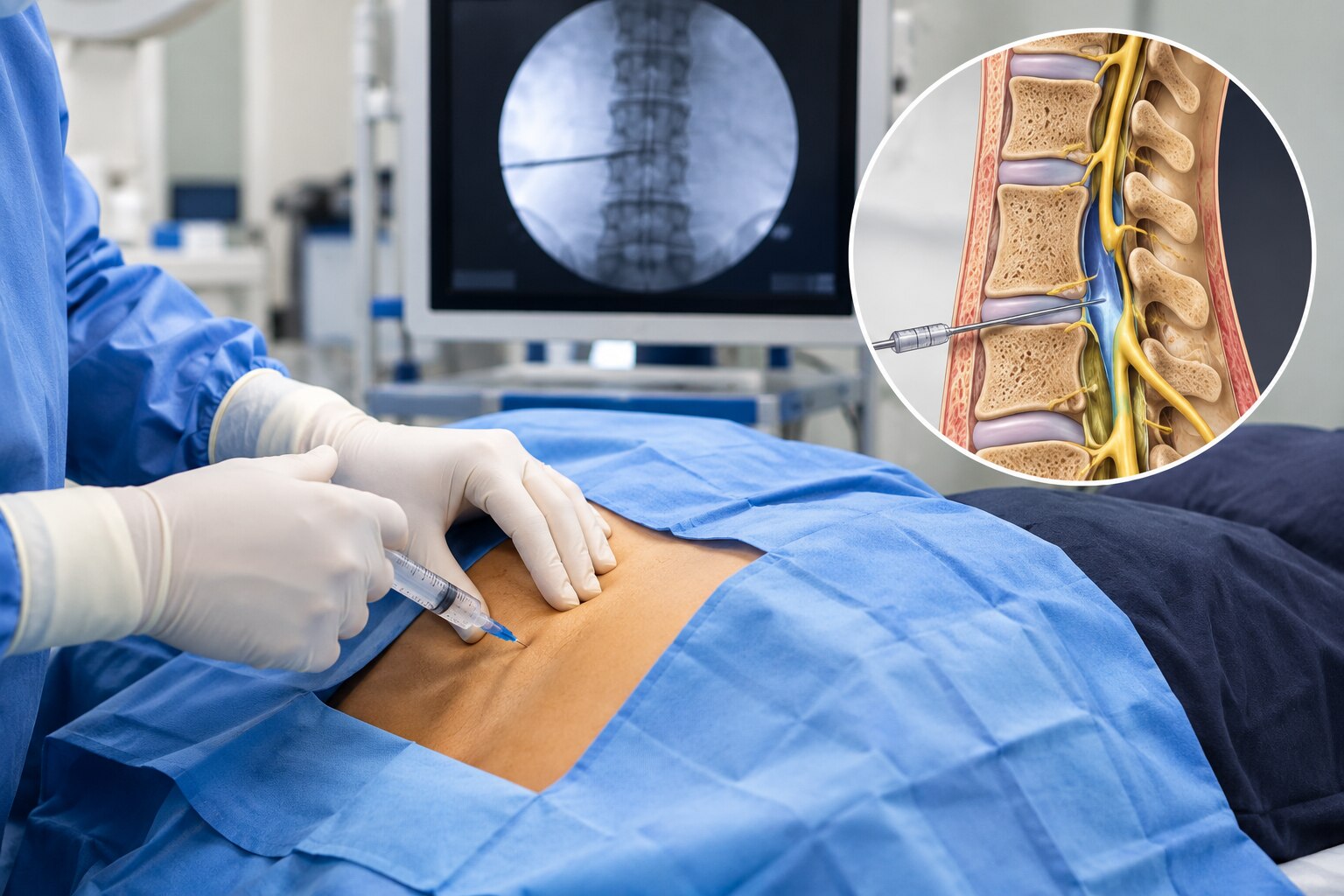
Pain travelling from the spine into an arm or leg deserves a different assessment from a strained muscle or ordinary back pain. By the end, you will know which symptoms and test findings support an epidural injection, what benefit to expect, and when another treatment or urgent surgical assessment takes priority.
Key takeaways
- Radiating arm or leg pain suggests nerve irritation more than isolated back pain.
- An injection needs symptoms, examination findings and scan results that match.
- Expect temporary relief or a treatment window, not guaranteed permanent pain removal.
- Compare the approach, medication, risks and alternatives with a spine specialist.
Does the pain pattern suggest an irritated spinal nerve?
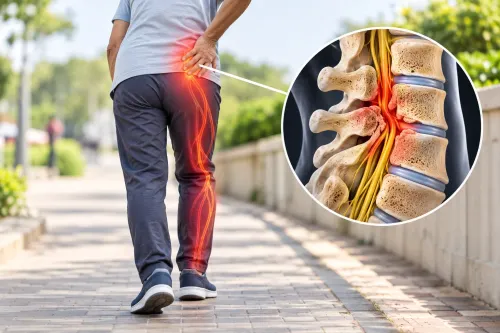
An epidural injection is mainly considered when spinal nerve irritation causes radicular pain that travels from the spine into an arm or leg.
The pain may feel sharp, electric or burning and follow a path into the buttock, thigh, calf, foot or arm, unlike muscle pain, which is usually local and tender, or facet-joint, hip and sacroiliac pain, which follows different movement and weight-bearing patterns.
Symptoms that strengthen the nerve-root pattern include:
- Dermatomal pain, with numbness and tingling from nerve pain following a recognisable strip of skin supplied by one nerve root.
- Pain reproduced by coughing, sneezing, sitting, walking or bending, or by a particular spinal position that narrows or tensions the nerve pathway.
- Objective weakness, such as reduced ankle lifting or grip strength, rather than pain-limited effort alone. Measurable weakness raises urgency and makes a targeted injection more relevant, although worsening weakness needs prompt assessment rather than delayed treatment.
Pain confined to the lower back or neck, without limb symptoms, sensory change or weakness, is a weaker indication for an epidural. A pain map cannot establish the diagnosis: muscle, facet, hip and sacroiliac disorders can overlap the same areas, and imaging findings must later match the symptoms and examination.
New bladder or bowel difficulty, saddle numbness or rapidly worsening leg weakness requires urgent medical assessment.
What examination and scan findings support an injection?
An injection has stronger support when the neurological examination and imaging point to the same irritated nerve root. The clinician compares strength in hip flexion, knee extension, ankle dorsiflexion, great-toe extension and plantarflexion, looking for muscle weakness rather than relying on pain alone.
Sensation is checked along dermatomes, while knee and ankle reflexes are compared for reflex changes.
For lumbar symptoms, a positive straight-leg-raise test or slump test reproduces radiating leg pain through nerve tension; isolated back pain is less supportive. For neck or arm symptoms, upper-limb tension tests and biceps, brachioradialis and triceps reflexes help identify cervical nerve-root involvement.
| Scan | What it can show | How it supports the decision |
|---|---|---|
| MRI | Disc herniation, foraminal narrowing or central canal stenosis | Supports an injection only when it matches the painful side, suspected nerve root and examination |
| CT | Bony foraminal or central canal narrowing | Useful when MRI is unsuitable or bone detail needs clearer definition |
A scan abnormality is not a diagnosis by itself. Disc bulges, degeneration and narrowing are common findings; if the painful side, dermatomal symptoms, weakness, reflexes and tension test do not fit, the scan does not establish that the finding causes pain or that an injection will help.
When is an injection worth considering, and what result is realistic?
An injection is worth considering after a sensible trial of conservative care before injection: activity modification, exercise-based physiotherapy, oral pain medicines or other non-invasive care. Acute severe sciatica is the exception; discuss it with a specialist earlier, particularly when nerve-root pain is intense or disabling.
| Purpose | What it is meant to do | Realistic result |
|---|---|---|
| Diagnostic epidural injection | Test whether a suspected nerve root is generating the pain | Temporary improvement supports the suspected source; it does not prove that treatment will provide lasting relief |
| Short-term symptom relief | Reduce radiating arm or leg pain from nerve-root inflammation | Modest relief that usually lasts weeks to a few months |
| Rehabilitation window | Make walking, sleep or exercise-based rehabilitation possible | A temporary reduction in pain, not removal of the underlying compression |
The best-supported use is selected lumbar disc herniation with radiculopathy. The injection does not remove a herniated disc or reliably change the condition’s long-term course, so epidural steroid injection benefits should be judged by function as well as pain.
NICE supports considering local anaesthetic plus steroid for acute, severe sciatica. It advises against epidural injections for neurogenic claudication caused by central spinal stenosis. In stenosis, adding glucocorticoid to lidocaine produced little or no extra short-term benefit over lidocaine alone, so an abnormal scan by itself is not a strong reason to inject.
Which approach, medication and safety checks matter?
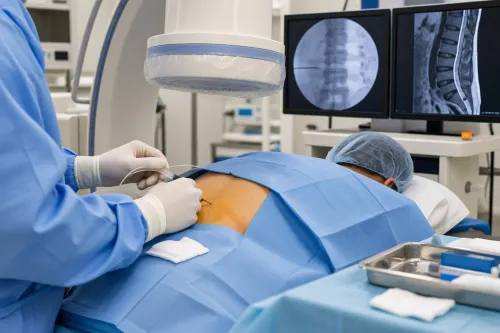
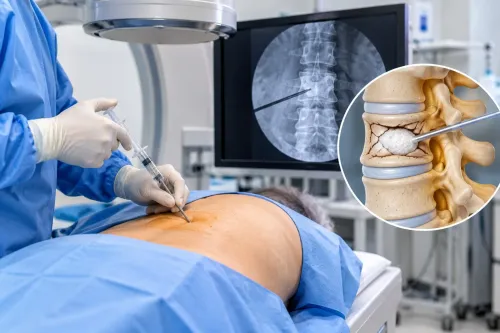
An interlaminar epidural injection enters the epidural space from the back and can spread across several nerve levels. A transforaminal epidural injection approaches the space beside a selected nerve root, while a caudal epidural injection enters through the sacral opening when higher access is difficult or broader spread is needed.
| Route | Main advantage | Practical limitation |
|---|---|---|
| Interlaminar | Covers several levels | Less selective targeting |
| Transforaminal | Targets one suspected nerve root | Greater concern about vascular injury, especially in the cervical spine |
| Caudal | Provides broader spread through the sacral opening | Medication may be less concentrated at one nerve root |
The route changes the target, expected spread and risk. The usual medication is a local anaesthetic and corticosteroid: the anaesthetic can numb pain quickly but briefly cause leg or arm weakness, while the corticosteroid’s anti-inflammatory effect develops later and can temporarily raise blood glucose.
Before proceeding, ask the clinician to review:
- Anticoagulants and antiplatelet drugs; never stop them independently. The holding plan depends on the medicine, dose, kidney function, injection route and clotting risk.
- Kidney function, diabetes, bleeding disorders and any active or suspected infection.
- Allergy to the planned medication or contrast agent.
Cervical transforaminal injections require contrast-guided imaging, a technique that reduces arterial injection, and a non-particulate steroid. Rare epidural corticosteroid complications include spinal cord infarction, paralysis, stroke and death; these drugs are not FDA-approved specifically for epidural administration.
How should an injection be compared with other treatments?
Compare the treatment goal, not just the procedure label. Continued conservative care suits symptoms that are improving and lets you build strength without procedural risk. A nerve-root block is more targeted than a general epidural injection and can test whether one suspected root is causing the pain, while also providing relief.
| Option | What it does | When it fits |
|---|---|---|
| Continued conservative care | Exercise, physiotherapy, medicines and activity changes | Symptoms are tolerable, stable or improving |
| Nerve-root block | Places medication beside a selected nerve root for targeted diagnosis or relief | One root and one side match the examination and imaging |
| Radiofrequency procedure | Disrupts pain signals from selected facet joints | Confirmed facet-joint pain, not compressive nerve-root pain |
| Epidural injection | Delivers local anaesthetic and corticosteroid for temporary inflammation and pain control | Radicular pain when short-term relief could support sleep, walking or rehabilitation |
| Epidural neurolysis | Attempts to address adhesions or restricted medication spread in selected chronic cases | Persistent symptoms after prior treatment when adhesions are suspected; it is not interchangeable with an epidural injection |
| Surgery | Decompresses the nerve or spinal canal | Progressive weakness, severe structural compression or cauda equina warning signs |
The epidural injection versus surgery decision changes urgently with new bladder or bowel dysfunction, saddle numbness or rapidly worsening leg weakness. Do not delay assessment for an injection. Spine And Pain Management Centre in Kalyan can help match the examination, imaging and treatment goal before you choose among these options.
Related services
Pain Treatment ₹700 Dr Prakash Deshmukh at Spine and Pain Management Centre in Kalyan provides advanced Epidural Injections Treatment for effective relief from back... View service → |
Pain Treatment ₹700 Dr Prakash Deshmukh at Spine and Pain Management Centre in Kalyan offers advanced Epidural Neurolysis Treatment for patients suffering from chronic... View service → |
Frequently asked questions
Does the pain pattern suggest an irritated spinal nerve?
Pain that travels from the spine into an arm or leg, especially with tingling, numbness or weakness, is more consistent with radicular nerve pain than isolated back pain.
What examination and scan findings support an injection?
The neurological examination and imaging should identify a nerve affected at the same spinal level as your symptoms. A scan finding without matching symptoms does not establish a reason for injection.
When is an injection worth considering, and what result is realistic?
Consider it when nerve pain remains limiting after appropriate initial treatment and the expected benefit outweighs the risks. Relief may be temporary or create a window for rehabilitation; permanent relief is not guaranteed.
Which approach, medication and safety checks matter?
Discuss whether a transforaminal, interlaminar or caudal approach fits the affected area, which medication will be used, and checks for infection, bleeding risk, diabetes and other safety concerns.