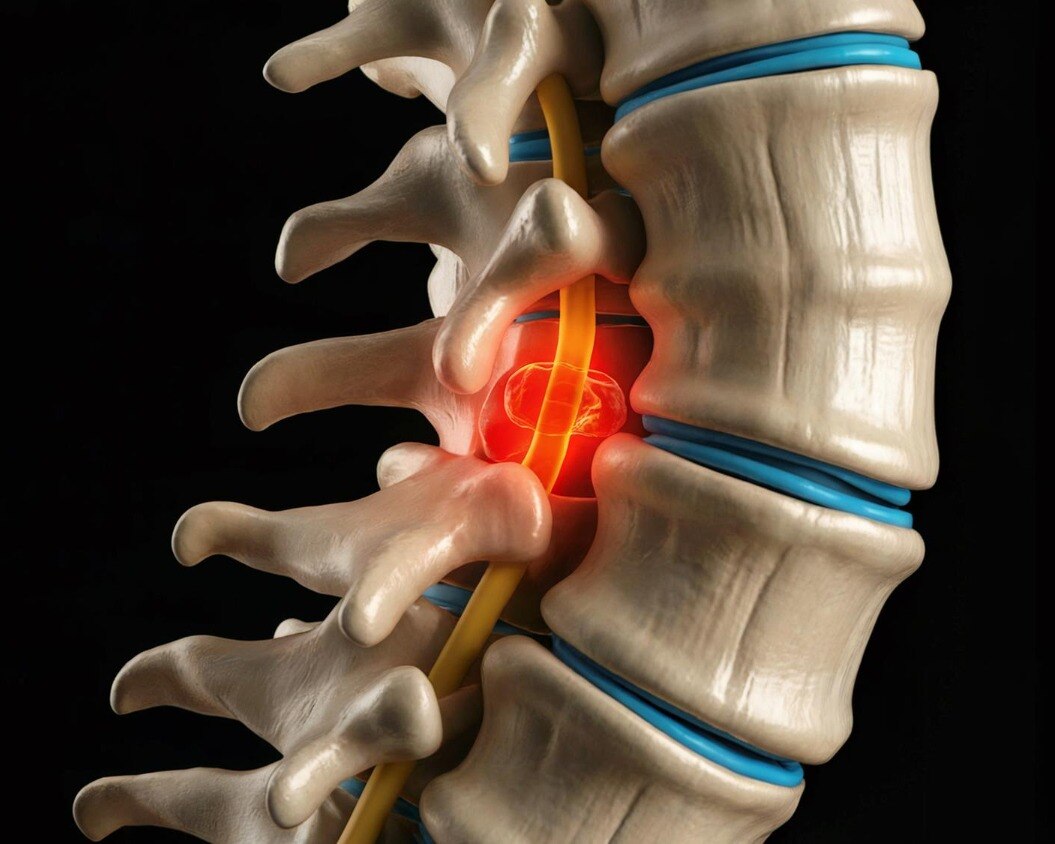
Pain in your back, neck, arm or leg does not prove that a disc has herniated. The pattern of pain, altered sensation and weakness, together with a targeted neurological examination and carefully selected imaging, helps identify whether a displaced disc is affecting a nerve and whether another condition needs attention.
Key takeaways
- Numbness or weakness in one limb can indicate nerve-root compression.
- Seek urgent care for bladder or bowel changes, saddle numbness, or worsening leg weakness.
- MRI shows disc and nerve compression; examination connects scan findings to symptoms.
- A disc finding alone does not determine treatment; symptoms and function guide decisions.
What is the difference between a herniated, bulging, slipped and degenerated disc?
A “slipped disc” has not literally slipped out of position. It is a common term for Disc Herniation, in which the disc’s inner material moves through a weakened outer layer.
A report may call this a broad-based protrusion, an extrusion extending beyond the disc space, or a sequestration where a fragment is no longer connected to the parent disc. These describe shape, not symptom severity.
| Term | What it means | What it does not tell you |
|---|---|---|
| Herniated disc | Displaced disc material; includes protrusion, extrusion or sequestration | How severe your pain will be |
| Bulging disc | The disc extends beyond its usual boundary across a broad area | That a nerve is compressed |
| Slipped disc | Informal name usually used for a herniated disc | That the entire disc has moved out of place |
| Degenerated disc | Wear-related or age-related changes within the disc | That degeneration is causing your symptoms |
Herniated Disc Symptoms depend on the affected level and whether a nerve is irritated. They can include local neck or back pain, arm or leg pain, tingling, pins and needles, numbness and muscle weakness.
Cervical herniation may cause symptoms in the neck, shoulder, arm or hand. Thoracic herniation may produce band-like pain around the chest or upper abdomen. Lumbar herniation may affect the buttock, leg or foot.
Coughing, sneezing, straining, sitting or a particular spinal position can worsen nerve-related pain. That pattern supports irritation but cannot establish the diagnosis alone. An MRI finding also needs to match your symptoms and examination, because bulging, degeneration and some herniations occur without pain.
Which symptoms suggest nerve-root compression, and which require urgent care?
Back or neck pain alone provides limited evidence of a herniated disc. Stronger clues are pain travelling into an arm or leg, tingling, numbness in a recognisable dermatome, or measurable weakness. Coughing, sneezing, straining or certain spinal positions can worsen nerve-root irritation, but none proves the diagnosis.
These patterns form the core of Herniated Disc Symptoms.
| Pattern | What it suggests | Action |
|---|---|---|
| Local back or neck pain only | Non-specific spinal pain | Arrange clinical review if it persists or worsens |
| Arm or leg pain with dermatomal numbness, tingling or weakness | Nerve-root compression | Seek a Herniated Disc evaluation; the clinician will compare skin territories, muscle actions, reflexes and gait |
| New urinary retention, bladder or bowel loss, saddle numbness, or rapidly worsening weakness in one or both legs | Cauda equina syndrome or severe nerve compression | Seek emergency assessment; do not wait for routine imaging |
| Fever, recent serious infection, intravenous drug use, immune suppression, cancer history, unexplained weight loss, major trauma, osteoporosis, prolonged steroid use or persistent night pain | Possible infection, malignancy or fracture | Contact a clinician promptly because this requires a different diagnostic pathway |
Emergency symptoms matter even when back pain is mild or absent. Go to emergency care for severe symptoms affecting both legs, new difficulty starting urination, loss of bladder or bowel control, numbness around the genitals or inner thighs, or rapidly progressive leg weakness. These warning signs can signal serious nerve compression.
What happens during a Herniated Disc evaluation?
A Herniated Disc evaluation starts with your history and a neurological examination, before a scan is ordered.
Expect questions about when symptoms began, what triggered them, where pain travels, whether coughing or sitting changes it, which movements worsen it, how far you can walk, and whether you have weakness, altered sensation, or bladder and bowel changes.
Tell the clinician about previous treatment, injuries, cancer, infection, immune suppression, steroid use, and other medical conditions. Fever, recent serious infection, intravenous drug use, unexplained weight loss, significant trauma, osteoporosis, or prolonged steroid use can point to infection, cancer, or fracture rather than a disc problem.
| Examination component | What happens | What it helps assess |
|---|---|---|
| Walking | You walk normally and heel-to-toe | Balance, gait, and leg control |
| Spinal movement | You bend, extend, and rotate your spine | Painful or restricted movements |
| Straight-leg raise | The clinician raises a straightened leg | Lumbar nerve-root irritation |
| Reflexes | Tendon reflexes are checked | Nerve-root function |
| Strength | Specific muscle actions are tested | Weakness linked to a nerve level |
| Sensation | Skin territories on the limbs are compared | Numbness or altered sensation |
The straight-leg-raise test stretches lumbar nerve roots. A positive result supports nerve irritation but does not prove a herniated disc; a negative result does not exclude every disc problem, particularly at another level or nerve.
The clinician combines these findings with pain distribution and competing diagnoses to reach a Spinal Disc Diagnosis, rather than treating one test as a stand-alone answer.
Which tests confirm a spinal disc diagnosis?
An MRI without contrast is usually the preferred test for suspected lumbar nerve-root compression when symptoms persist or progress after about six weeks of appropriate conservative care and an injection or operation is being considered. Do not assume immediate imaging is needed for uncomplicated acute low-back pain without red flags.
MRI can show displaced disc material and contact with a nerve root, but it cannot prove that the finding causes your pain. Disc degeneration, bulging, protrusion and some extrusions also appear in people without symptoms. Match the reported level and side to your pain pattern and examination findings.
| Test | What it shows | When it helps |
|---|---|---|
| MRI without contrast | Disc material, nerve-root contact and other soft-tissue findings | Persistent or progressive symptoms when injection or surgery is being considered |
| Plain X-ray | Bone alignment, fracture, deformity or instability | Suspected bone disease; it cannot show the disc, nerve root or most herniations |
| CT | Bone detail and some spinal narrowing | MRI is unavailable, contraindicated or technically inadequate |
| CT myelography | Nerve-root and canal outlines after intrathecal contrast | Selected cases requiring more detail; it is more invasive than MRI |
| EMG and nerve-conduction studies | Electrical evidence of nerve dysfunction | Unclear cases, mismatched imaging, or suspected radiculopathy, peripheral neuropathy or plexopathy |
A sound Spinal Disc Diagnosis combines imaging with the Herniated Disc evaluation, including strength, sensation, reflexes, gait and nerve-tension findings. Early electrodiagnostic testing can miss changes because denervation takes time to develop.
What does a herniated-disc diagnosis mean for your next decision?
An MRI finding should guide your next decision only when it matches the painful side, spinal level, symptom pattern and objective examination. This correlation is the core of a useful Spinal Disc Diagnosis.
A disc bulge, protrusion or extrusion can exist without causing symptoms, so the scan alone does not prove that the disc explains every complaint.
| Next option | What it means | When it fits |
|---|---|---|
| Monitoring | Track pain, sensation, strength and function without immediate procedures | Symptoms are stable and no emergency signs or progressive weakness are present |
| Rehabilitation and medication | Use guided activity, physiotherapy and prescribed medicines to improve function and reduce pain | Symptoms are manageable and recovery is expected with non-operative care |
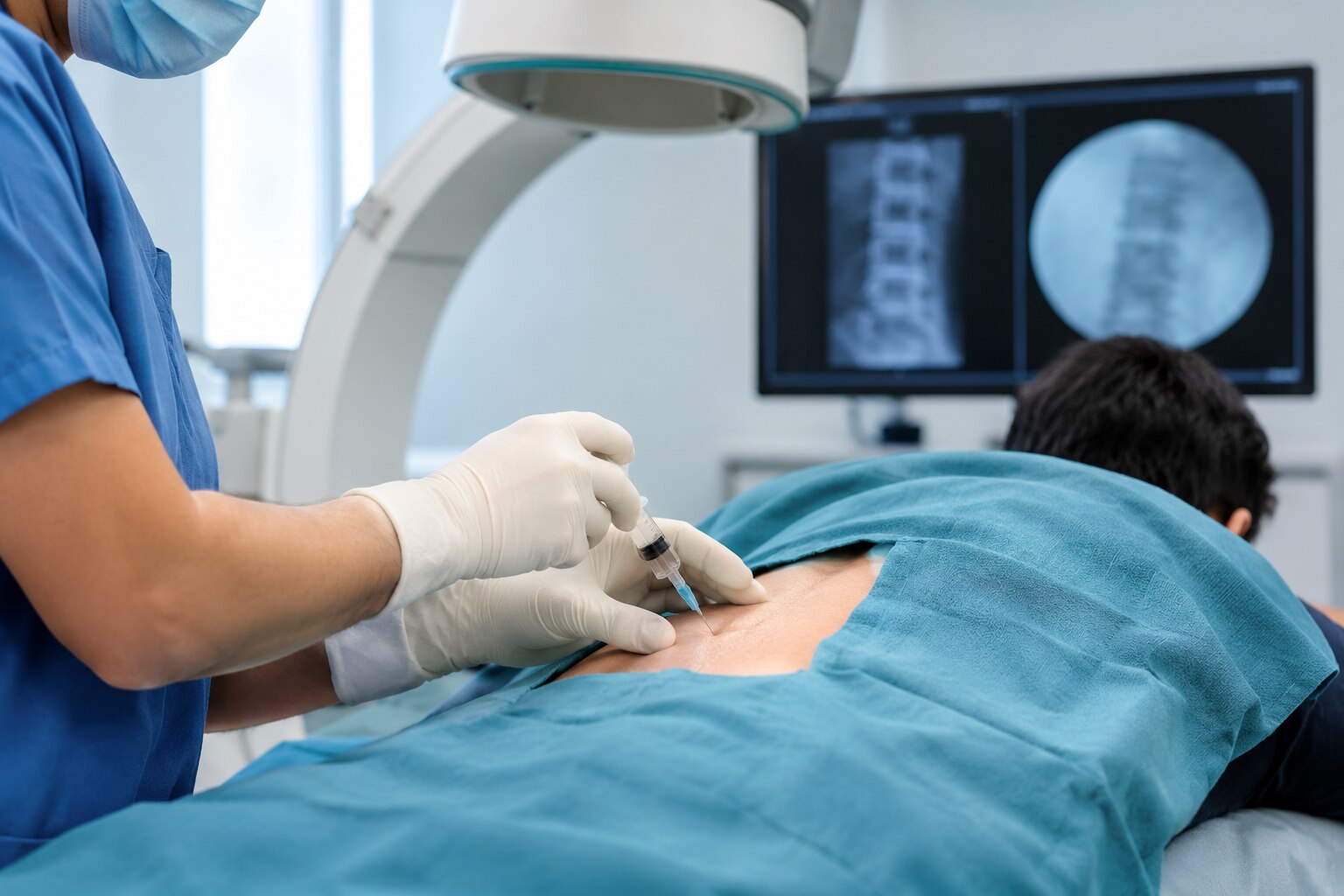
| Injection review | Consider targeted treatment after confirming the suspected nerve and level | Radiating pain persists despite appropriate conservative care |
| Surgical referral | Ask a spine surgeon to assess decompression or another operation | Progressive neurological loss, emergency signs or disabling symptoms resist suitable treatment |
Without worsening weakness, urinary retention, loss of bladder or bowel control, saddle-area numbness or severe symptoms in both legs, a herniated disc does not automatically require surgery. Many people improve with time and non-operative care.
A specialist performing a Herniated Disc evaluation can compare your images with strength, sensation, reflexes and gait, then investigate another cause if they do not match. Spine And Pain Management Centre may be relevant for a focused review of persistent radiating pain, suspected nerve compression or an unclear report.
Ask what the examination found, which level is implicated, what improvement to expect and which change requires urgent reassessment.
Related services
Pain Treatment Backache / Slipped Disc Treatment ₹700 Backache and slipped disc can cause severe pain, stiffness, numbness, and difficulty in daily activities. View service → |
Pain Treatment ₹700 Dr Prakash Deshmukh at Spine and Pain Management Centre in Kalyan offers advanced Epidural Neurolysis Treatment for patients suffering from chronic... View service → |
Frequently asked questions
What is the difference between a herniated, bulging, slipped and degenerated disc?
A bulging disc extends beyond its usual boundary without a tear, while a herniated disc involves inner disc material moving through a weakened outer layer. “Slipped disc” is a common term for disc herniation, and degeneration describes wear-related changes that can occur without nerve compression.
Which symptoms suggest nerve-root compression, and which require urgent care?
Radiating pain, tingling, numbness, or weakness along an arm or leg suggest nerve-root compression. Seek urgent care for new bladder or bowel problems, numbness around the groin or buttocks, or rapidly worsening weakness.
What happens during a herniated disc evaluation?
A clinician reviews your pain pattern, onset, medical history, and warning signs, then checks walking, posture, strength, reflexes, sensation, and movements that reproduce symptoms.
Which tests confirm a spinal disc diagnosis?
MRI provides the clearest view of discs, nerve roots, and spinal canal narrowing. X-rays show bones and alignment but not the disc itself; CT or electromyography may help in selected cases.
What does a herniated-disc diagnosis mean for your next decision?
Treatment depends on pain severity, weakness, function, examination findings, and whether imaging matches your symptoms. Options range from monitored self-care and physiotherapy to injections or surgery for persistent or severe nerve compression.
Related services
Pain Treatment ₹700 Dr Prakash Deshmukh at Spine and Pain Management Centre in Kalyan provides advanced Epidural Injections Treatment for effective relief from back... View service → |
Pain Treatment ₹700 Sciatica causes sharp, radiating pain from the lower back to the leg due to irritation or compression of the sciatic nerve. View service → |
Pain Treatment ₹700 Dr Prakash Deshmukh at Spine and Pain Management Centre in Kalyan offers advanced Spine Endoscopy, a minimally invasive procedure used to diagnose... View service → |
Keywords