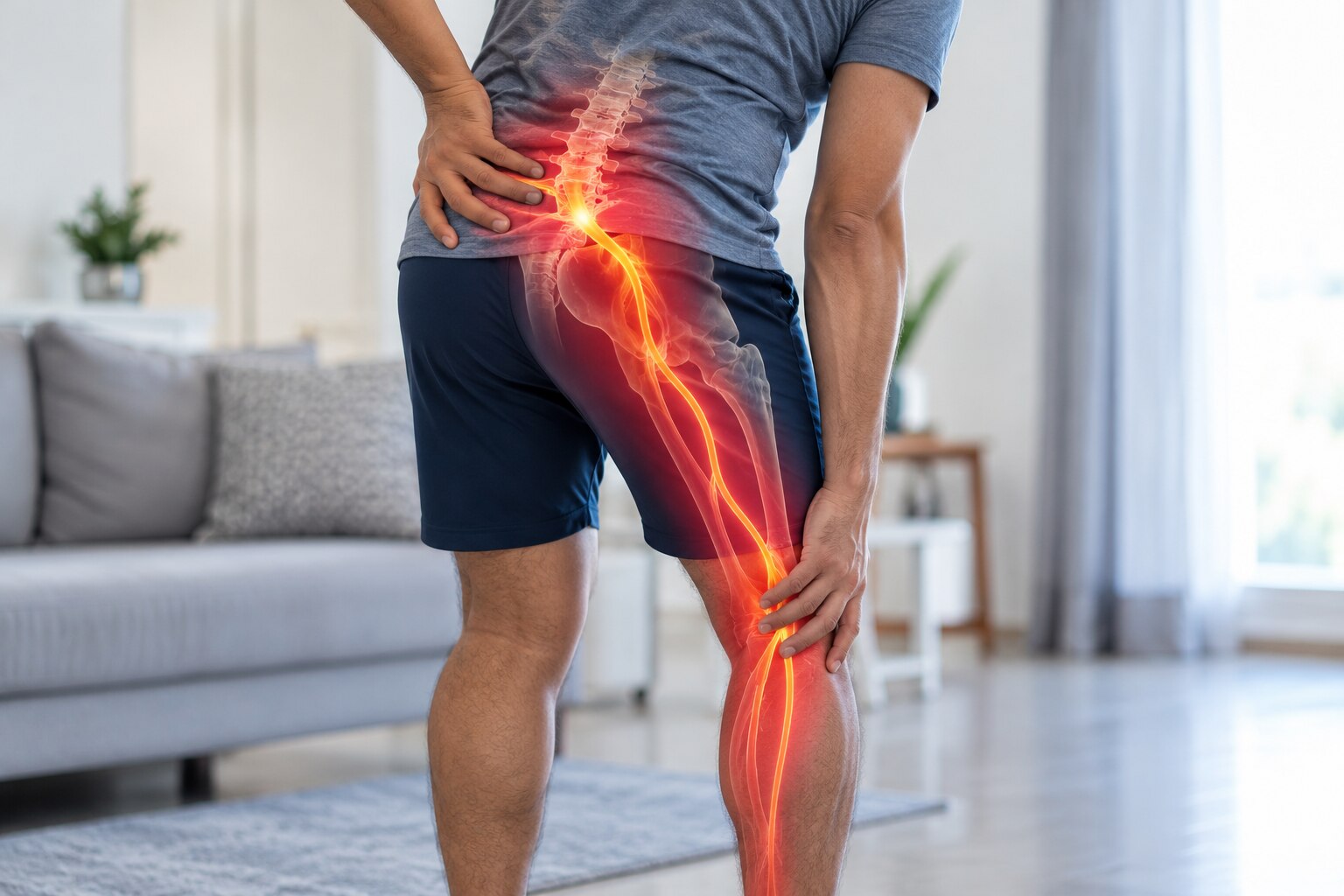
A problem near one nerve root in the lower spine can cause pain, tingling or weakness far away in the buttock, calf or foot. By the end, you will be able to recognise the usual symptom patterns, distinguish nerve pain from common look-alikes, identify urgent warning signs and understand when examination or imaging changes the next step.
Key takeaways
- Nerve-root irritation can send pain from the lower back into the leg.
- Pain below the knee, numbness, or weakness points toward nerve involvement.
- Seek urgent care for bladder changes, saddle numbness, or worsening leg weakness.
- Assessment combines symptom history, strength and reflex tests, and selective imaging.
How One Irritated Nerve Root Can Cause Pain in the Leg
One irritated lumbar nerve root can cause pain far below the lower back because that root carries sensation from a specific part of the leg. The sciatic nerve route starts with L4 and L5 roots emerging from the lumbar spine, joined by S1, S2 and S3 roots from the sacral spine.
These roots form the sciatic nerve, which leaves the pelvis through the buttock, passes beneath the gluteal muscles and travels down the back of the thigh before dividing near the knee into branches reaching the lower leg and foot.
Radiculopathy versus referred pain becomes clearer when you separate the terms:
| Term | Meaning | What may be present |
|---|---|---|
| Radicular pain | Pain along a nerve-root distribution | Burning, tingling, shooting or electric sensations in the buttock or leg |
| Radiculopathy | Radicular pain with objective nerve dysfunction | Measurable weakness, a reduced reflex or sensory loss |
| Referred pain | Pain spreading from back, disc, joint or muscle tissues without nerve-root dysfunction | Aching or spreading pain without a consistent nerve pattern |
Inflammation around one root can strongly activate its sensory fibres, so leg pain may dominate even when back pain is mild. The leg symptoms can feel severe because the irritated fibres continuously transmit abnormal signals. Referred pain can also reach the buttock or leg, but it does not automatically mean sciatica.
What the Cause and Symptom Pattern Can Tell You
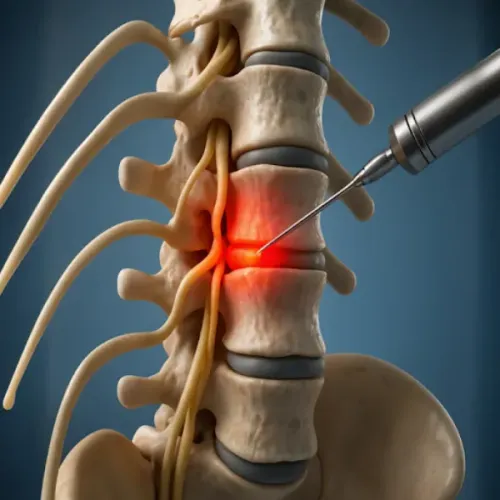
A lumbar disc herniation, age-related narrowing, spondylolisthesis or nerve-root inflammation can irritate a lumbosacral root and produce sciatica. The L4–L5 and L5–S1 levels are frequent sites because the L4 L5 S1 nerve roots contribute to the sciatic nerve and carry signals into the leg and foot.
A symptom map guides assessment but cannot prove the diagnosis.
Pain below the knee points more toward nerve-root involvement than pain limited to the back or buttock. Burning, tingling and electric-shock sensations suggest irritated sensory fibres; numbness or weakness suggests measurable nerve dysfunction. Coughing, sneezing, bending and lifting can raise pressure around a disc or tense the irritated root.
Prolonged sitting keeps the hip and lower spine flexed, which can increase pressure or tension. One-sided irritation follows one root, while symptoms can reach the foot because that root supplies sensation and movement along the limb.
| Root | Useful symptom pattern | Possible movement or reflex change |
|---|---|---|
| L4 | Front of thigh, inner knee or shin | Weak knee extension; reduced knee reflex |
| L5 | Outer leg, top of foot and big toe | Weak big-toe lifting |
| S1 | Back of calf, outer or sole-side foot | Weak ankle push-off; reduced ankle reflex |
These patterns overlap, and lumbar spinal stenosis can affect more than one root. A slipped vertebra in spondylolisthesis can narrow the nerve exit, while inflammation can cause severe radiating pain without weakness. Examination must match the symptoms to the side and level.
When Leg Pain Is Not Sciatica—and When It Is Urgent
Pain below the knee is more suggestive of nerve-root irritation, but it is not conclusive. Sciatica mimics can produce similar buttock or leg pain, so use the pattern and trigger as clues—not as a diagnosis.
| Pattern | Practical clue |
|---|---|
| Nerve-root pain | Burning, tingling, electric-shock pain or numbness travels from the back or buttock down one leg, sometimes into the foot. |
| Sacroiliac joint pain | Sacroiliac joint pain usually centres near one side of the buttock and may worsen with turning, standing or transferring weight, without a clear nerve-line pattern. |
| Hip arthritis | Hip arthritis often centres on the groin and limits hip movement; pain can spread to the thigh or knee. |
| Hamstring injury | Pain follows a muscle strain, sprint, fall or forceful stretch and remains concentrated along the back of the thigh. |
| Peripheral neuropathy | Peripheral neuropathy symptoms often affect both feet in a stocking pattern rather than following one spinal nerve. |
| Vascular leg pain | Vascular pain can start with walking and ease with rest; swelling, colour change or a cold foot needs prompt assessment. |
Seek urgent medical assessment for new urinary retention, loss of bladder or bowel control, numbness around the saddle area, rapidly worsening weakness or foot drop. Fever, major trauma or unexplained weight loss also require urgent review rather than delayed self-treatment.
What a Sciatica Assessment Actually Involves
A sciatica examination tests whether your symptoms and physical findings fit a particular nerve root. The clinician asks where pain, tingling, numbness or weakness travels, whether coughing, sneezing, bending, lifting or sitting triggers it, and whether symptoms reach below the knee or foot.
They watch your walking pattern, then compare heel walking, toe walking, muscle strength, sensation, knee and ankle reflexes and the straight-leg raise. Pain reproduced by lifting the straightened leg supports nerve-root irritation, but it does not prove the diagnosis alone.
| Test | What it shows | When it adds value |
|---|---|---|
| X-ray | Bone alignment, fractures and some slippage | Suspected fracture or structural bone change; it shows nerve compression poorly |
| MRI for sciatica | Discs, nerve roots, stenosis and other soft tissues | Suspected serious disease, progressive weakness, persistent symptoms despite appropriate care, or planned injection or surgical opinion |
| EMG nerve test | Electrical evidence of nerve or muscle dysfunction | Uncertain diagnosis or nerve-root level; it does not replace examination |
Routine imaging adds little for uncomplicated symptoms. A disc bulge or degenerative change is common without pain, so MRI findings must match the painful side, spinal level and examination. A scan can mislead when its abnormality is incidental; the clinical pattern remains essential.
What Usually Helps—and When Specialist Treatment Is Considered
Many disc-related episodes improve without surgery over several weeks as inflammation settles and herniated material can regress. Persistent pain does not automatically mean permanent nerve damage, but progressive weakness changes the urgency. Prolonged bed rest is not recommended; normal activity and graded exercise are encouraged as tolerated. This is the core of sciatica self-care.
- Keep walking and change position instead of staying in bed.
- Resume daily tasks gradually, stopping before symptoms sharply escalate.
- Follow a structured exercise plan when pain allows, rather than forcing painful movements.
NICE advises against gabapentinoids, oral corticosteroids and benzodiazepines for sciatica because benefit is lacking and harm is documented. NSAIDs require checks for stomach bleeding, kidney disease and cardiovascular risk; use the lowest effective dose for the shortest suitable period.
Manual therapy belongs in an exercise-based package, not as a stand-alone cure. NICE does not recommend traction, acupuncture or TENS for this purpose.
An epidural injection for sciatica containing local anaesthetic and steroid can be considered for acute, severe symptoms. It aims to reduce pain temporarily; it does not remove a disc or reverse spinal narrowing, and procedural risks and limited benefit require discussion.
Spinal decompression surgery is considered when symptoms, examination and MRI agree and non-surgical care has not restored function. Seek urgent assessment for cauda equina syndrome or progressive major weakness.
In Kalyan, Spine And Pain Management Centre can help review examination findings and whether non-surgical or minimally invasive care fits. Treat regenerative injections cautiously: no injection reliably restores a compressed nerve, and FDA says advertised stem-cell or exosome products lack approval for broad orthopaedic or neurological uses.
Related services
Pain Treatment ₹700 Sciatica causes sharp, radiating pain from the lower back to the leg due to irritation or compression of the sciatic nerve. View service → |
Pain Treatment ₹700 Dr Prakash Deshmukh at Spine and Pain Management Centre in Kalyan offers advanced Epidural Neurolysis Treatment for patients suffering from chronic... View service → |
Frequently asked questions
Why does sciatica pain travel from the lower back into the leg?
An irritated lumbar or sacral nerve root can cause pain along the part of the leg supplied by that nerve, even when the irritation starts in the spine.
How can you tell whether leg pain is sciatica?
Sciatica often follows a path from the lower back or buttock into the leg and may include tingling, numbness, or weakness. A clinical examination helps distinguish it from muscle, joint, vascular, or other nerve conditions.
When is leg pain an urgent medical problem?
Seek urgent care for new bladder or bowel problems, numbness around the groin or inner thighs, or rapidly worsening weakness in the leg or foot.
What does a sciatica assessment involve?
A clinician reviews how the pain began and travels, checks walking, leg strength, sensation, and reflexes, and orders imaging when examination findings or persistent symptoms justify it.
What usually helps sciatica, and when is specialist treatment considered?
Treatment may include staying active within tolerable limits, targeted exercises, pain medicines, and treatment of the underlying cause. Consider specialist assessment when pain persists, weakness develops, diagnosis is uncertain, or symptoms interfere with daily activities.
Related services
Pain Treatment Backache / Slipped Disc Treatment ₹700 Backache and slipped disc can cause severe pain, stiffness, numbness, and difficulty in daily activities. View service → |
Pain Treatment ₹700 Dr Prakash Deshmukh at Spine and Pain Management Centre in Kalyan provides advanced Epidural Injections Treatment for effective relief from back... View service → |
Pain Treatment ₹700 Dr Prakash Deshmukh at Spine and Pain Management Centre in Kalyan offers advanced Spine Endoscopy, a minimally invasive procedure used to diagnose... View service → |