
Neck pain can come from an overworked muscle, age-related joint changes, a cervical nerve root, an injury, or a condition outside the neck itself. By the end, you will be able to recognise patterns that need urgent care, understand what an examination and scan can establish, and compare self-care, rehabilitation, medicines, procedures, and surgery more safely.
Key takeaways
- Pain with arm numbness or weakness needs prompt medical assessment.
- Imaging findings matter only when they match your symptoms and examination.
- Start with movement, targeted exercises, and clinician-guided pain relief.
- Consider procedures when symptoms persist despite appropriate conservative treatment.
Which common causes best match your neck-pain pattern?
Pain location rarely identifies one damaged structure. Muscle strain or ligament strain from repetitive work, prolonged screen posture, an awkward sleep position, or whiplash can overlap with cervical spondylosis, disc herniation, nerve compression, inflammatory disease, or referred pain from the shoulder or upper back.
| Pattern | Possible cause | Clues |
|---|---|---|
| Neck or upper-shoulder ache | Mechanical strain or cervical spondylosis | Stiffness after work, sustained posture, or waking; spondylosis affects discs and facet joints |
| Arm pain with tingling, numbness, or weakness | Disc herniation or nerve compression | Symptoms follow a consistent arm or hand pattern rather than staying only in the neck |
| Pain after impact | Whiplash or other injury | Symptoms began after a collision, fall, or sudden neck movement |
| Morning stiffness with several painful joints | Inflammatory disease | Swelling, prolonged stiffness, or other systemic symptoms |
| Neck pain with shoulder or upper-back symptoms | Referred pain | Shoulder movement or upper-back problems reproduce the discomfort |
Most acute or subacute neck pain is nonspecific mechanical, also called axial, pain: no single pain-generating structure can be identified confidently, and many episodes improve over days to weeks.
Repeated episodes, steadily worsening pain, reduced function, or symptoms that return despite appropriate self-care justify evaluation for cervical spine disease, shoulder pathology, or a headache disorder. Neck movement or restricted motion supports cervicogenic headache; nausea, light sensitivity, or a throbbing one-sided headache points toward migraine.
Tension-type headache differs again, and neck tightness alone does not prove the neck caused it.
How can you tell routine neck pain from a problem needing urgent care?
Routine muscular or mechanical neck pain is more likely when discomfort stays in the neck or upper shoulder, movement is limited by pain, and strength, sensation, reflexes, hand use, and walking remain normal.
Cervical radiculopathy is more concerning when pain travels into the arm or hand, or when tingling, numbness, weakness, altered reflexes, or symptoms follow a consistent nerve pattern. Neck pain alone does not establish nerve compression.
New loss of hand dexterity, dropping objects, gait imbalance, brisk or abnormal reflexes, or progressive arm weakness raises concern for spinal-cord compression and needs prompt assessment.
Treat these neck pain red flags as follows:
- Emergency care: call emergency services for rapidly developing weakness, inability to walk, new loss of bladder or bowel control, or neck pain after serious trauma.
- Same-day medical advice: contact a clinician today for fever with severe stiffness, new neurological symptoms, severe unremitting night pain, unexplained weight loss, known cancer, immunosuppression, or intravenous-drug use.
- Routine appointment: book an assessment for recurrent, persistent, or function-limiting pain without those warning signs.
Do not drive yourself if weakness, walking difficulty, or bowel or bladder changes are progressing rapidly. A neurological examination can distinguish uncomplicated pain from cervical radiculopathy or possible spinal-cord compression.
What will an examination and scan actually tell you?
An examination tells you whether neck pain is mechanical, nerve-related, or linked to spinal-cord involvement; a scan shows structure, not pain by itself.
The clinician asks when symptoms began, what provokes them, whether pain reaches the arm, what numbness or weakness feels like, whether trauma occurred, and how symptoms affect sleep, work, walking, and hand use.
- The physical assessment may include neck range-of-motion testing, shoulder assessment, strength, sensation, and reflexes. Gait and hand-dexterity checks look for signs of spinal-cord dysfunction.
- Spurling testing, shoulder-abduction relief, and an upper-limb tension test can support suspected nerve-root irritation. Interpret them alongside the neurological examination, not as stand-alone diagnoses.
- Routine imaging is usually unnecessary for uncomplicated acute neck pain without red flags or neurological deficit. An X-ray can help assess selected chronic or traumatic presentations.
- MRI is preferred when nerve-root or spinal-cord compression, infection, malignancy, or persistent symptoms require evaluation. It can show disc bulges, narrowing, arthritis, and other changes, but age-related abnormalities are common without pain.
A scan becomes useful when its findings match your symptoms and examination. An abnormal disc or joint alone does not identify the pain source or justify an injection or operation.
Which treatments are reasonable first steps, and what should you avoid?
For uncomplicated mechanical neck pain, the sensible first step is activity modification, not bed rest or immobilisation. Stay active within tolerable limits, use heat or ice for short-term comfort, and follow an exercise-based physiotherapy plan.
| Option | Purpose | Effort and risk |
|---|---|---|
| Activity and exercise | Restore movement and function | Requires steady practice; prolonged rest causes stiffness and deconditioning |
| Heat or ice | Provide temporary comfort | Low effort; does not correct the cause |
| Physiotherapy | Build strength, mobility, and control | Requires consistent work over several weeks; passive treatment alone is less useful |
| Medicines | Reduce pain enough to move | Benefits and risks depend on your health and the medicine |
Raise your screen so its top is near eye level, keep the keyboard and mouse close, and take a brief movement break every 30 to 60 minutes. Choose a sleep position that keeps your neck neutral instead of forcing it sharply forward or sideways.
Ask a clinician or pharmacist before taking anti-inflammatory drugs if you have kidney disease, a stomach ulcer or bleeding history, take blood thinners, have uncontrolled hypertension, or have cardiovascular disease. Acetaminophen carries dose-related liver risk. Muscle relaxants can impair driving, and opioids are not routine care for uncomplicated neck pain.
Stop an exercise and seek clinical advice if pain spreads into the arm, numbness appears, or weakness develops. Avoid forceful neck manipulation, prolonged neck-brace use without advice, and repeated painkiller use that masks recurring symptoms without investigating the cause.
When do injections, minimally invasive procedures, or surgery make sense?
A procedure makes sense only when the examination, symptom pattern, imaging, and treatment goal point to a specific pain generator. Mild, unassessed neck pain is a poor reason to choose an injection or operation.
| Option | What it targets | When it makes sense |
|---|---|---|
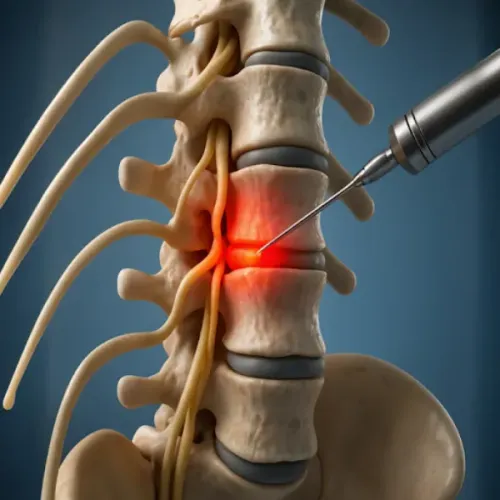
| Cervical epidural steroid injection | Inflamed nerve-root pain | Selected radicular pain after assessment; relief is usually short term, and it does not remove compression. Cervical transforaminal approaches carry rare risks including spinal cord infarction, paralysis, stroke, and death. |
| Radiofrequency ablation | Suspected facet-mediated pain | After diagnostic work-up, often controlled or dual medial-branch blocks. It does not treat disc disease or nerve-root compression; pain can return as nerves recover. |
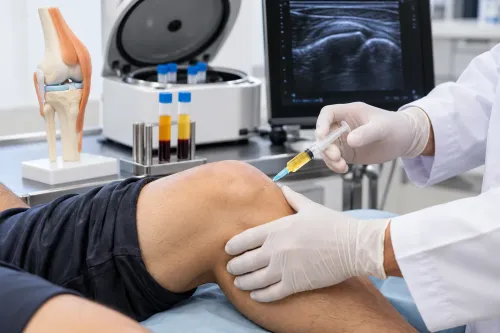
| Regenerative injections | Platelet-rich plasma, bone-marrow concentrate, or cell-based products | Evidence remains limited and inconsistent. Marketing claims do not establish an approved or proven treatment. |
| Surgery | Structural nerve or spinal-cord compression | Progressive weakness, clinically significant myelopathy, or persistent disabling radicular symptoms with matching MRI findings despite appropriate nonoperative care—not an abnormal scan alone. |
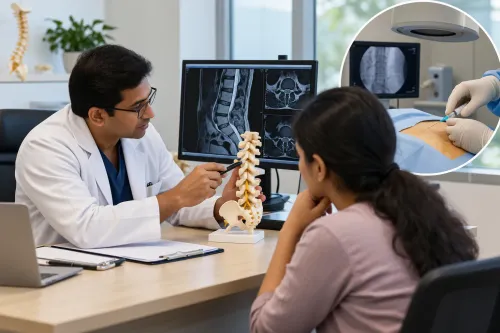
Dr. Prakash Deshmukh at Spine And Pain Management Centre can help weigh examination findings, imaging, risks, alternatives, and your goals before a minimally invasive option is considered.
Related service
Pain Treatment ₹700 Neck pain can cause stiffness, headaches, shoulder discomfort, and difficulty in daily activities such as working, driving, or sleeping. View service → |
How should you prepare for a specialist visit and measure progress?
Bring scan images and reports, a medication and supplement list, prior treatment records, relevant blood-test results, and a short symptom diary. Note onset, arm symptoms, weakness, triggers, sleep disruption, and what improved or failed. Expect a focused history, neck and shoulder movement testing, and neurological checks of strength, sensation, reflexes, gait, and hand dexterity.
Imaging follows findings and symptom duration, not routine habit.
- What is the leading diagnosis, and which findings support it?
- What would change the plan?
- What are the treatment goals: pain reduction, restored movement, sleep, work, or prevention of neurological decline?
- What are the risks, alternatives, expected time to benefit, and signs requiring urgent contact?
| Severity | Follow-up | What to track |
|---|---|---|
| Uncomplicated pain | After an initial rehabilitation period | Pain, movement, sleep, work, medication reliance |
| Neurological symptoms | Earlier reassessment | Arm pain, strength, sensation, walking, hand function |
Use these progress measures—not an MRI image alone: arm pain, strength, sensation, walking, neck movement, sleep, work capacity, and medication reliance.
Frequently asked questions
Which common causes best match your neck-pain pattern?
Muscle strain often follows repetitive work, prolonged screen posture, or awkward sleep. Neck pain with arm pain, tingling, numbness, or weakness can indicate nerve irritation from a disc problem or cervical spondylosis. Shoulder, upper-back, whiplash, and inflammatory conditions can also refer pain to the neck.
How can you tell routine neck pain from a problem needing urgent care?
Seek urgent medical care after major trauma, or when neck pain occurs with arm or leg weakness, loss of coordination, trouble walking, severe headache, fever, unexplained weight loss, or loss of bladder or bowel control. New numbness affecting both arms or legs also needs prompt assessment.
What will an examination and scan actually tell you?
An examination checks neck movement, strength, reflexes, sensation, coordination, and signs of nerve or spinal cord involvement. X-rays show bone alignment and wear. MRI shows discs, nerves, the spinal cord, and soft tissues. A scan supports diagnosis only when its findings match your symptoms and examination.
Which treatments are reasonable first steps, and what should you avoid?
Stay gently active, vary your posture, use short periods of heat or cold, and follow a targeted exercise plan. Ask a clinician or pharmacist about suitable pain relief. Avoid prolonged bed rest, forceful neck manipulation, unprescribed steroid use, and exercises that increase arm weakness or neurological symptoms.
When do injections, minimally invasive procedures, or surgery make sense?
A specialist may discuss an injection when confirmed nerve or joint pain persists despite appropriate non-surgical care. Minimally invasive procedures or surgery are considered when significant nerve compression, spinal cord compression, instability, or progressive weakness requires structural treatment. The decision depends on examination findings, imaging, duration, and functional impact.