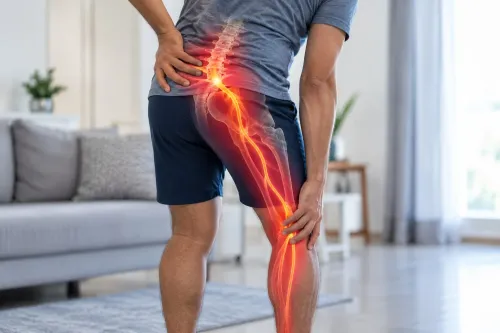
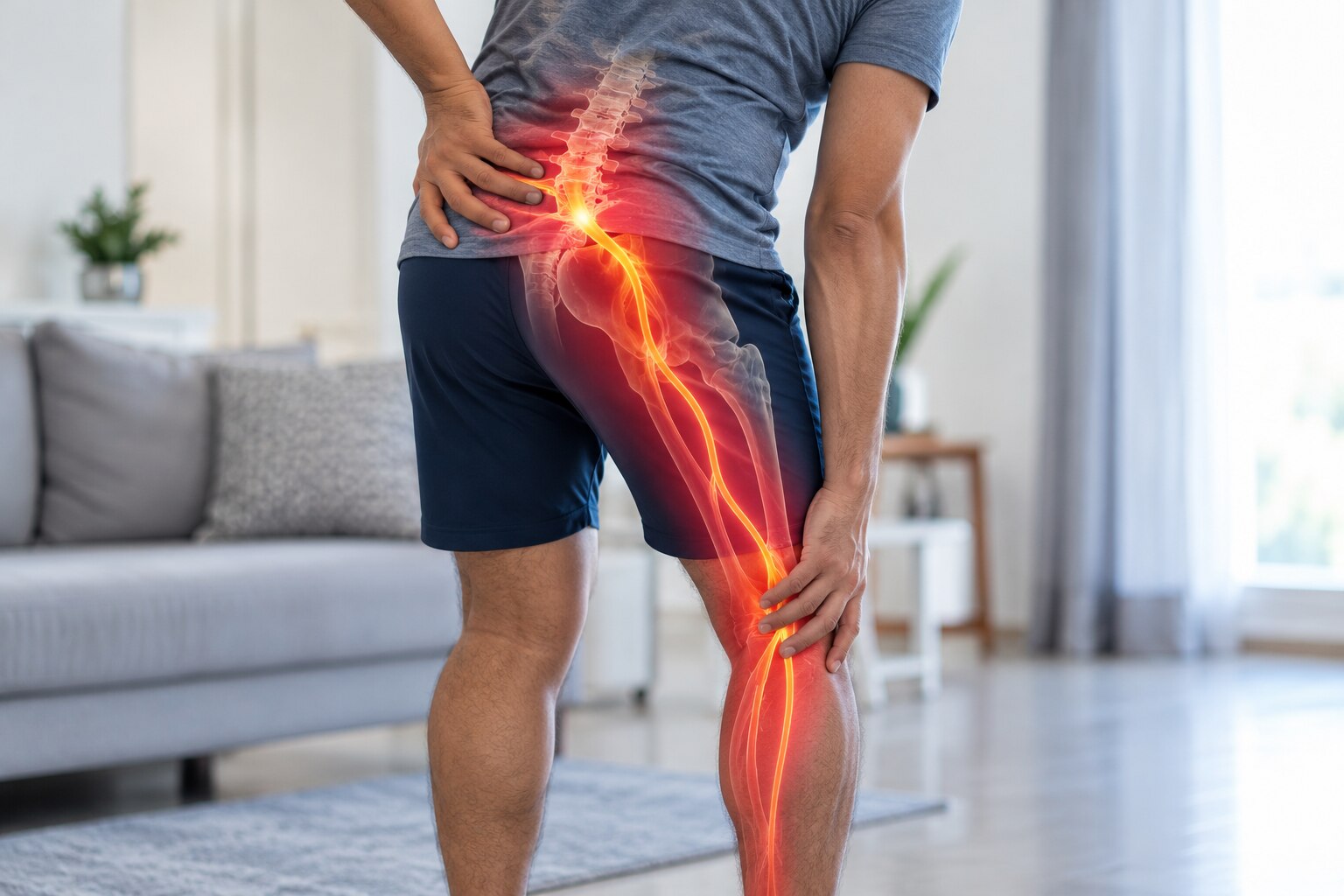
A lumbar disc can hurt in two different ways: the damaged disc itself can cause local back pain, while displaced material and inflammatory chemicals can disturb a nearby nerve root. By the end, you will be able to distinguish common nerve symptoms, recognise urgent warning signs, and understand why examination findings matter as much as an MRI report.
Key takeaways
- A slipped disc can cause back pain, leg pain, tingling, numbness or weakness.
- Pain travelling below the knee often follows the path of an irritated nerve root.
- An MRI shows disc changes but does not prove they cause your symptoms.
- Seek urgent care for new bladder or bowel loss, saddle numbness or worsening weakness.
What changes inside a slipped disc?
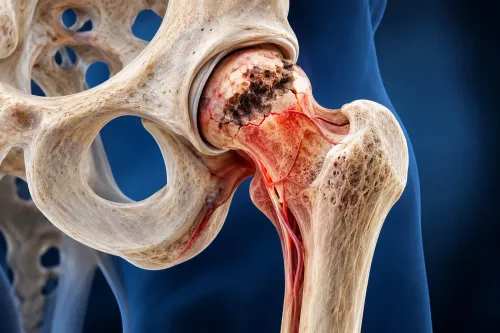
A slipped disc changes when the soft nucleus pulposus shifts through a weakened or torn annulus fibrosus, the disc’s tough outer ring. That change can produce local back pain, irritate a spinal nerve root, or do both.
1. A bulging disc extends beyond its usual boundary without a focal tear in the annulus. A protruding disc, also called a protrusion or protruding disc, pushes through a defect, but the displaced material remains connected by a base wider than the material projecting outward.
2. An extrusion has a narrower connection to the remaining disc than the displaced portion. If that portion breaks away completely, it is called a sequestration, or separated fragment. These scan descriptions show shape, not proof that the disc causes symptoms.
3. Symptoms begin when the displaced material reaches a nerve root. It can press against the root mechanically, while chemicals released by damaged disc tissue can inflame and sensitise it. Severe pain therefore does not require dramatic compression on an MRI, and a large herniation can remain painless if it misses the relevant nerve.
Pain that stays mainly in the lower back is local disc pain, but it is less specific because muscles, joints and other tissues can produce similar symptoms. Pain, tingling, numbness or weakness travelling into the buttock and leg—especially below the knee—points more strongly to nerve-root involvement. A scan finding alone cannot identify the pain source.
How nerve-root symptoms travel through the leg
Pain or altered sensation below the knee can still come from a lumbar disc because an irritated nerve root carries signals along a long route through the leg, not just from the disc level.
- L4 nerve root: symptoms may affect the front of the thigh, knee and inner lower leg. Weakness can make straightening the knee difficult, such as rising from a chair or climbing stairs.
- L5 nerve root: symptoms commonly travel along the outer leg to the top of the foot. You may struggle to lift the foot or big toe, catch your toes on the ground, develop foot drop or find heel-walking difficult.
- S1 nerve root: symptoms often run down the back of the leg toward the outer edge or sole of the foot. Weakness can prevent you from standing on tiptoe or pushing the foot downward.
The sensation itself also matters. Numbness means reduced feeling, while pins and needles describes prickling or tingling. Burning suggests an irritated sensory nerve; electric-shock pain feels sudden and shooting. True weakness means the muscle cannot perform a task, not merely that pain makes the task uncomfortable.
These patterns are useful clues, not a diagnosis. A clinician compares the pain map with sensation, muscle power, reflexes and gait, because symptoms can overlap and a scan finding does not prove that disc is causing every leg complaint.
Why movement changes symptoms—and why an MRI is not the diagnosis
Movement changes symptoms because posture and pressure alter an irritated nerve root. Coughing or sneezing can briefly increase pressure around it. Sitting and bending aggravate some disc-related symptoms, while walking, standing or lying down may ease or worsen them in different ways.
This pattern helps, but pain intensity does not measure compression: inflammation can cause severe radicular pain with modest narrowing, while a large herniation can remain painless if it misses the relevant nerve.
- Note which movements change the leg symptoms, not only the back pain. Record whether pain, tingling or numbness travels below the knee, and whether weakness affects heel-walking, toe-walking or climbing stairs.
- Match that pattern with the examination. Reduced sensation, altered reflexes or loss of muscle power matter more than pain severity alone.
- Treat imaging as supporting evidence. A clinician must decide whether the abnormality shown is affecting the nerve that matches your symptoms.
An MRI for slipped disc shows discs, nerve-space narrowing and soft tissues well, but it is not the diagnosis. Disc degeneration appears in about 37% of symptom-free 20-year-olds and 96% of 80-year-olds; disc bulging appears in about 30% and 84%, respectively.
| Test | Shows | Does not show |
|---|---|---|
| X-ray | Bones and alignment | A nerve root or disc herniation |
| MRI | Discs, soft tissue and narrowing | Whether a finding causes symptoms |
| Electrodiagnostic testing | Nerve function through nerve-conduction studies and electromyography | The disc itself |
The final interpretation combines pain distribution, sensation, strength, reflexes and gait.
Which symptoms need urgent care?
New difficulty starting urination, urinary retention, loss of bladder control, loss of bowel control, saddle numbness around the genitals or anus, or rapidly worsening weakness in both legs requires urgent assessment.
These cauda equina symptoms can signal severe nerve compression or cauda equina syndrome, so do not wait for a routine appointment or rely on self-management.
| Symptom pattern | Action | Why it matters |
|---|---|---|
| New urinary difficulty, retention, or bladder or bowel loss | Seek urgent medical assessment now | The nerves controlling bladder and bowel function may be compressed |
| Saddle numbness or rapidly worsening weakness in both legs | Seek urgent medical assessment now | This can indicate cauda equina syndrome or severe nerve compression |
| Persistent numbness, weakness affecting walking or gripping, or repeated pain below the knee | Arrange a routine clinical assessment | Ongoing sensory or motor change needs a neurological examination |
| Recurring symptoms or difficulty with ordinary activities | Arrange a routine clinical assessment | The cause and treatment plan need review |
Pain alone is less concerning than objective loss of sensation or power, but do not dismiss progressive leg weakness because the pain is manageable. A clinician can test strength, reflexes, sensation, gait, heel-walking and toe-walking.
For uncomplicated sciatica, prolonged bed rest is not recommended. Continue ordinary movement as tolerated, and temporarily reduce a specific activity when it clearly worsens leg pain, tingling or weakness.
How clinicians decide between monitoring, treatment and specialist review
The decision turns on nerve function, symptom duration and whether a test result would change treatment—not on the MRI alone.
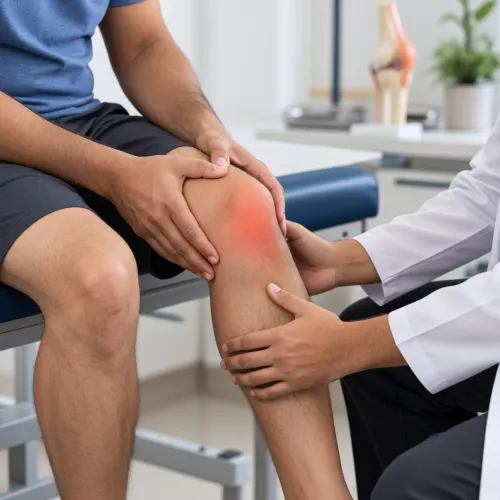
1. During a slipped disc assessment, the clinician checks muscle power, reflexes, sensation, gait, heel-walking, toe-walking and movements that reproduce symptoms. Progressive weakness, persistent numbness or difficulty walking warrants closer review than pain alone.
2. For uncomplicated low-back pain or sciatica, routine imaging is not a default. MRI becomes more useful when symptoms persist, neurological findings appear, or an injection or surgery is being considered; it should clarify whether the scan matches the symptoms.
Many cases improve over several weeks with non-surgical treatment, and extruded or separated disc fragments are more likely to shrink, although this cannot predict your recovery.
3. Treatment planning combines activity modification, rehabilitation and safe pain relief. NSAIDs require checks for stomach ulcers or bleeding, kidney disease, heart and blood-pressure risks, pregnancy and drug interactions; use the lowest effective dose for the shortest appropriate period. NICE advises against gabapentinoids, oral corticosteroids and benzodiazepines for sciatica.
4. An epidural injection containing local anaesthetic and steroid may provide modest short-term relief for acute severe symptoms, but it does not remove the fragment. Discectomy is considered when consistent imaging and symptoms persist despite treatment, or weakness progresses.
In Kalyan, Spine And Pain Management Centre can help correlate examination findings with imaging before choosing specialist, minimally invasive or surgical review.
Related services
Pain Treatment Backache / Slipped Disc Treatment ₹700 Backache and slipped disc can cause severe pain, stiffness, numbness, and difficulty in daily activities. View service → |
Pain Treatment ₹700 Dr Prakash Deshmukh at Spine and Pain Management Centre in Kalyan offers advanced Epidural Neurolysis Treatment for patients suffering from chronic... View service → |
Frequently asked questions
How does a slipped disc cause back pain and nerve symptoms?
The nucleus pulposus can push through a weakened annulus fibrosus, causing local inflammation or pressure near a spinal nerve root. This can produce back pain, leg pain, tingling, numbness or weakness.
Why can slipped-disc symptoms travel down the leg?
An irritated lumbar nerve root sends symptoms along its pathway into the buttock, thigh, calf or foot. The exact distribution depends on which nerve root is affected.
Does an MRI prove that a slipped disc is causing pain?
No. An MRI can show disc bulges, protrusions or herniations, but clinicians must match those findings with your symptoms, examination and movement pattern.
Which slipped-disc symptoms need urgent medical care?
Seek urgent care for new bladder or bowel control problems, numbness around the genitals or anus, or worsening leg weakness. These symptoms can indicate serious nerve compression.
Related services
Pain Treatment ₹700 Dr Prakash Deshmukh at Spine and Pain Management Centre in Kalyan provides advanced Epidural Injections Treatment for effective relief from back... View service → |
Pain Treatment ₹700 Sciatica causes sharp, radiating pain from the lower back to the leg due to irritation or compression of the sciatic nerve. View service → |
Pain Treatment ₹700 Dr Prakash Deshmukh at Spine and Pain Management Centre in Kalyan offers advanced Spine Endoscopy, a minimally invasive procedure used to diagnose... View service → |